
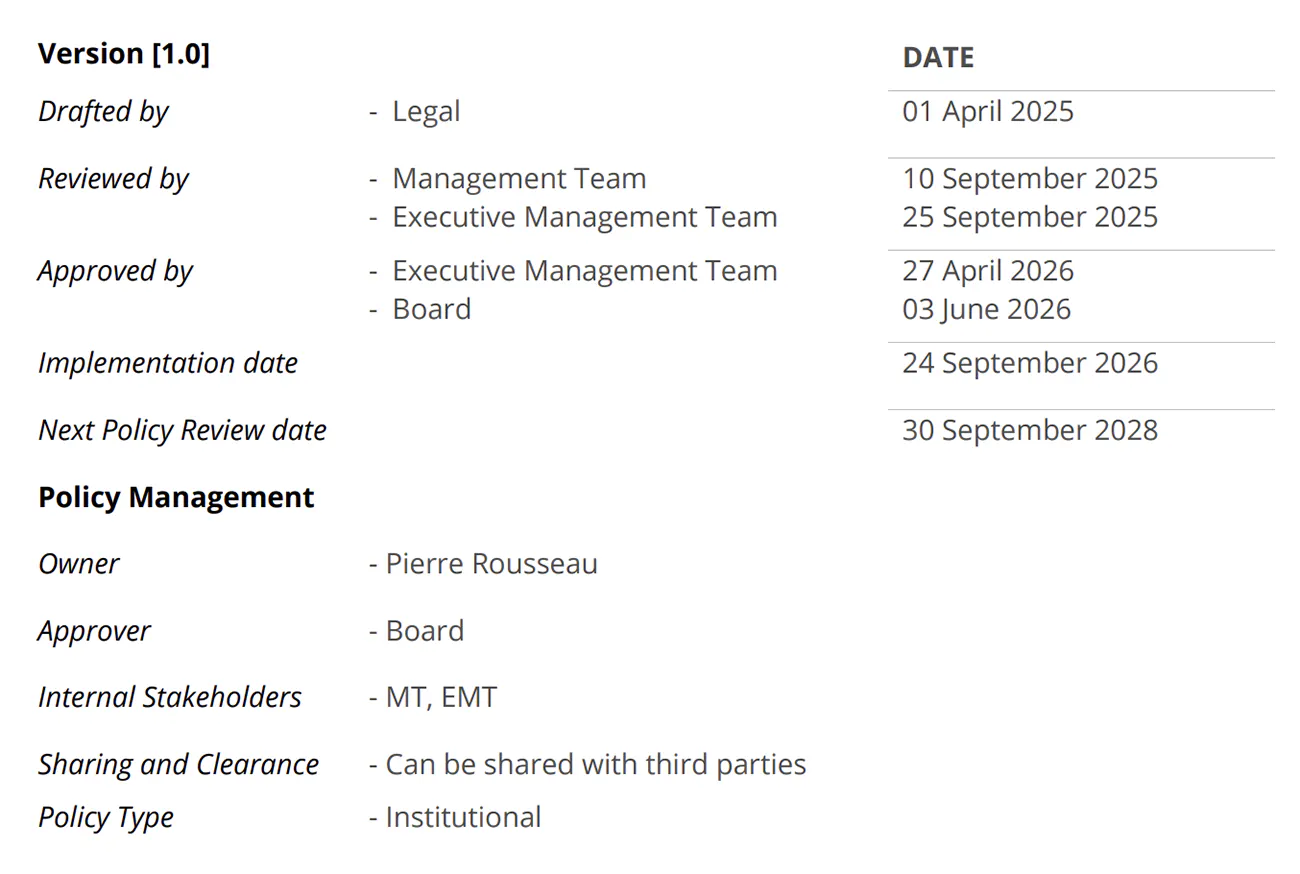
Version 1.0
1 Introduction
1.1 Legal Principles applicable: Corruption crimes in Switzerland
As a non-governmental organisation headquartered in Switzerland, GS operates under the applicable provisions of Swiss law and is subject to the rules governing corruption offences as defined in Swiss law.
These provisions cover the definition of offence or misdemeanour and bribery of public officials (both domestic and foreign), bribery in the private sector, granting or accepting undue advantages, and trading in influence. GS is committed to full compliance with these legal standards as defined under Swiss law or any other applicable regulations.
The Compliance Officer is responsible for ensuring the respect, implementation, and monitoring of these obligations throughout GS’s operations, as further detailed in Section 2.6.2. of this policy.
1.2 Purpose
The purpose of this policy is to:
1.2.1. Establish and implement effective mechanisms to prevent, detect, report, investigate, and sanction fraud, bribery, and corruption involving GS staff and the other individuals or entities referred to in Section 2 of this policy.
1.2.2. Set out the rules and standards of conduct regarding anti-fraud, anti-bribery, and anti-corruption that must be observed by GS employees and all other individuals or entities referred to in Section 2 subject to this policy.
1.2.3. Inform third parties of the ethical standards and behaviour they are entitled to expect from GS, thereby reinforcing trust and accountability in all interactions.
1.3 GS’s Anti-Fraud and Corruption Principles
GS follows three key principles to prevent fraud and corruption:
- a) Zero Tolerance for Fraud and Corruption
GS does not tolerate any form of fraud or corruption, whether direct or indirect. It takes steps to reduce related risks in all its activities. - b) Transparency and Accountability
GS is committed to being open and responsible to its users, stakeholders, partners, and donors. It provides clear information on how funds are used and ensures proper tools are in place for sound financial and operational management. - c) Commitment to Professionalism
GS designs, manages, and evaluates its programmes with professionalism. It builds on its experience to use resources effectively and deliver quality results.
1.4 Links and relevance to other policies and guidance
This policy is aimed at guiding GS staff and any other individuals or entities referred to in Article 2 of this policy, and must be considered together with:
- Gold Standard for the Global Goals (GS4GG)
- GS’s Whistle-Blowing Policy;
- GS’s Grievance Policy;
- GS’s Conflict of Interest Policy;
- GS’s Privacy Management and Procedure (i.e. Data Protection);
- GS’s Know your Customer and Anti-money laundering Policy;
- GS’s HR Policy, Code of Conduct, procedures, and staff handbooks;
- GS Governance and its Programmes.
The present regulations are updated and are accessible at all times on the company website
2 Scope of Application
2.1 Scope
2.1.1. This policy applies to all GS employees and Governance members.
2.1.2. The provisions of this policy may also be applied to any individual or entity that works with or for GS.
2.1.3. This policy applies, in particular, to consultants, stakeholders, partners, VVBs, experts, project owners, project developers, Impact Registry account holders, suppliers, users or stakeholders, and any other Associated Individuals or Entities.
2.2 Policy Statement
GS adopts a zero tolerance approach towards corruption and is committed to respecting the highest standards in terms of responsibility and transparency in its activities. To this end, GS’s Anti-fraud, Bribery and Corruption Policy:
- a) Encourages prevention;
- b) Promotes detection;
- c) Sets out a clear investigation procedure;
- d) Sets out a mechanism of sanctions.
2.3 Information and Adherence to Policy
2.3.1. This policy is issued under the authority of GS. All GS employees, as well as the other individuals or entities referred to in Section 2 of this policy, are required to act in full compliance with its provisions. They must be familiar with the content of this policy and any subsequent amendments.
2.3.2. Any GS employee or representative who is responsible for negotiating employment terms must ensure that newly recruited staff are made aware of this policy and formally commit to its full respect.
2.3.3. It is the duty of GS employees with managerial responsibilities, and of the other relevant individuals or entities referred to in Section 2, to ensure that those under their supervision comply with this policy.
2.3.4. This policy shall be considered an integral part of the working conditions for GS employees and of the contractual or operational framework for other individuals or entities referred to in Article 2, as from the date on which they acknowledge having read and understood it.
2.3.5. Failure to comply with this Policy and procedures may result in disciplinary actions, including:
· Warnings and reprimands.
· Suspension or termination of contract.
· Reporting to relevant authorities for potential legal action.
2.3.6. GS will periodically review and, if necessary, revise this policy to ensure its continued relevance, effectiveness, and alignment with applicable legal and ethical standards.
2.4 Anti-Fraud, Bribery, Corruption Mechanisms
2.4.1. Zero Tolerance and Prevention
2.4.1.1. Prohibition of all forms of Corruption and Fraud
GS employees and individuals or entities referred to in section 2 of this policy are strictly prohibited from engaging in any act of corruption, bribery, or fraud, whether directly or indirectly, as defined in this policy.
Under no circumstances shall GS staff or any Associated Individual or Entity exploit their position for personal gain or advantage.
2.4.1.2. Organizational Commitment to Prevention
GS recognises that the most effective way to combat corruption is by fostering a culture of ethical conduct and responsible resource use. To this end, GS has developed and implemented a range of internal control systems and preventative mechanisms across its different departments and functions.
2.4.1.3. Prevention and Detection Measures
GS has adopted the following measures to prevent and identify corruption and fraud:
- Promoting GS’s core values and policies, ensuring all staff and individuals or entities referred to in section 2 are guided by a clear Code of Conduct;
- Establishing internal controls (particularly at financial and accounting level) and regularly verifying their effectiveness;
- Providing staff with relevant training to strengthen judgement and capacity to manage corruption risks;
- Ensuring constructive, respectful dialogue with beneficiaries and stakeholders to promote downward accountability;
- Conducting due diligence on individuals or entities referred to in section 2, especially regarding their anti-corruption and anti-fraud commitments
2.4.2. Duty to report
2.4.2.1. Reporting Obligations
- GS promotes transparency and has appointed a Compliance Officer reachable at [email protected]
- Any GS employee or Associated Individual or Entity who believes they are being asked to act unlawfully or unethically, or in breach of this policy, must report the concern to GS and, in any case, via the designated email address above.
- Allegations or suspicions of fraud, corruption, or other misconduct must be reported promptly to the relevant supervisor, or via the designated email address above.
- Where reporting to the relevant supervisor is not appropriate, the employee may escalate the concern to the Compliance Officer, in any case via the designated email address above.
- Individuals who report concerns in good faith and based on reasonable suspicion shall be protected from retaliation or adverse consequences.
- Abuse of the reporting mechanism may be subject to disciplinary sanctions.
- GS shall take appropriate measures to protect the confidentiality of the reporter and any persons implicated.
- GS may be legally or contractually required to inform donors or relevant authorities of confirmed cases of fraud or corruption, following an internal investigation.
2.4.3. Response to Corruption Attempts
2.4.3.1. Employee Conduct in case of Corruption Attempts
Employees and associated entities are personally responsible for remaining vigilant and responding appropriately to any actual or attempted act of corruption or bribery.
Upon being offered an undue advantage, the following steps must be taken:
- Refuse the offer;
- Identify the individual if possible;
- Minimise engagement and avoid unnecessary contact;
- Retain evidence (e.g. gifts) securely and handle them minimally;
- Seek witnesses where possible;
- Prepare a written report immediately;
- Notify the relevant supervisor and report via the designated email address above.
Significant gifts (i.e.: above 50 US$ value) that could not be refused must be handed over to GS with a written explanation.
If faced with a demand for a facilitation payment:
- Clearly state that the practice violates GS policy;
- Refuse the payment;
- Document the interaction (name, request, ID if possible);
- Report the incident promptly via the designated email address above.
In cases of serious coercion or physical threat, staff are not expected to place themselves or others at risk. Such incidents must be reported without delay.
2.4.4. Investigation Framework
2.4.4.1. Principles Governing Investigations
All investigations conducted under this Policy shall adhere to the following fundamental principles:
- Legality and Proportionality: Investigative measures must be lawful, proportionate to the allegations, and respectful of applicable Swiss law, including data protection and employment law requirements.
- Independence and Impartiality: Investigations shall be conducted in an objective, unbiased, and independent manner. Any individual with a conflict of interest must be excluded from the investigation process.
- Presumption of Good Faith: Allegations shall be assessed without prejudice. The fact of being subject to an investigation does not imply wrongdoing.
- Right to be Heard: Individuals subject to allegations shall be given a fair opportunity to present their views, provide evidence, and respond to findings before conclusions are finalised.
- Confidentiality: Information shall be disclosed strictly on a need-to-know basis to preserve the integrity of the investigation and protect all parties involved.
2.4.4.2. Internal Investigation Process
- Reports must be submitted in accordance with Section 2.4..2.1. and will be acknowledged by the Compliance Officer.
- The acknowledgement will outline the review process, estimated timeline, and any request for further information.
- Complaints are assessed and managed by GS, depending on their nature and severity.
- All parties must:
- Cooperate fully with the investigation;
- Preserve relevant documentation;
- Maintain strict confidentiality. - Proven cases are recorded in a fraud and corruption register, including actions taken.
2.4.4.3. Structured Fact-Finding Procedures
GS recognises that thorough, well-documented fact-finding is essential to ensure the credibility, defensibility, and effectiveness of investigations.
Accordingly, investigations shall, where appropriate, include:
- Preliminary Assessment: A documented initial review to determine credibility, materiality, and whether a formal investigation is warranted;
- Investigation Plan: Definition of scope, methodology, resources, and timelines proportionate to the nature and complexity of the allegations;
- Evidence Collection: Systematic gathering and preservation of relevant information, including documents, financial records, electronic data, and witness testimony;
- Interviews: Conducted in a fair and consistent manner, with appropriate documentation of statements and respect for the rights of interviewees;
- Documentation and Chain of Custody: Maintenance of clear and auditable records to ensure the integrity and admissibility of evidence;
- Legal Oversight: Involvement of legal counsel where necessary to ensure compliance with applicable laws and to preserve legal privilege where appropriate;
- Reporting: Preparation of a reasoned investigation report setting out facts, findings, evidentiary basis, and recommendations.
- Findings must be based on a balance of probabilities, unless a higher standard is required by applicable law.
2.4.4.4. Interim Measures and Risk Mitigation
Where necessary to protect GS’s interests, reputation, or stakeholders, interim measures may be implemented during an investigation. These may include:
- Temporary suspension of individuals or activities;
- Restriction of access to systems, funds, or premises;
- Enhanced supervision or control measures;
- Preservation orders on documents and data.
Such measures must remain proportionate, time-bound, and subject to periodic review.
GS acknowledges that reporting and investigation mechanisms, while essential, may be subject to misuse, including:
- Knowingly false, frivolous, or malicious allegations;
- Use of complaints to settle personal disputes or exert pressure;
- Selective or misleading presentation of information;
- Reputational harm arising from unsubstantiated claims.
Any deliberate abuse of the reporting or investigation process constitutes a violation of this Policy and may result in disciplinary measures.
To mitigate such risks, GS shall implement the following safeguards:
- Threshold Assessment: No formal investigation shall be initiated without a documented preliminary assessment establishing reasonable grounds;
- Segregation of Functions: Clear separation between reporting intake, investigation, and decision-making functions where feasible;
- Documentation Standards: Comprehensive record-keeping to ensure transparency and accountability of investigative actions;
- Confidential Handling of Allegations: Protection of individuals from undue reputational damage until allegations are substantiated.
2.4.4.5. Investigation Authority
the Compliance Officer is solely authorised to conduct all internal inquiries related to fraud, bribery, or corruption involving GS or its associated individuals or entities. In cases involving the CEO, the authority to instruct, supervise, and, where necessary, replace or support the Compliance Officer in the conduct of an investigation shall rest with the Board.
Where the nature, complexity, sensitivity, or potential conflicts of interest so require, GS may decide to entrust all or part of an investigation to qualified external specialists, including legal counsel, forensic experts, auditors, or other independent professionals. The use of external investigators aims to ensure the highest standards of independence, technical expertise, and objectivity, and to reinforce adherence to the principles set out in this Policy.
External investigators shall be bound by strict confidentiality obligations and shall conduct their work in accordance with applicable laws, including Swiss legal and data protection requirements, as well as GS’s internal policies. Their mandate, scope of work, and reporting lines shall be clearly defined by the Compliance Officer.
GS remains responsible for the oversight of outsourced investigations and for ensuring that findings are assessed and acted upon in a fair, consistent, and timely manner.
2.4.4.6. Specific Procedure in Case of Allegations Involving the CEO
Where allegations, suspicions, or credible information of fraud, bribery, or corruption involve the Chief Executive Officer (CEO), the following specific procedures shall apply in order to ensure independence, impartiality, and appropriate governance oversight:
2.4.4.6.1. Immediate Escalation to the Board
The Compliance Officer shall immediately inform the Chair of the Board (or, where appropriate, the Vice-Chair or designated independent Board member) upon receipt of any allegation involving the CEO. The CEO shall not be informed at this stage where such notification could compromise the integrity of the preliminary assessment or investigation.
2.4.4.6.2. Board Oversight and Instruction
The Board (or a specifically mandated subset thereof, such as the Audit, Risk, and Finance Committee) shall assume direct oversight of the matter.
The Board shall provide formal instructions to the Compliance Officer regarding:
- Whether to proceed with a preliminary assessment or formal investigation;
- The scope, governance, and reporting lines of the investigation;
- The need to appoint external investigators or legal counsel.
2.4.4.6.3. Independence of the Investigation Function
In such cases, the investigation shall be operated independently from executive management, and all reporting lines shall be redirected to the Board or its designated committee. The CEO shall be excluded from any decision-making, oversight, or access to information relating to the investigation.
2.4.4.6.4. Use of External Expertise
Allegations involving the CEO may require the engagement of independent external experts (e.g. external legal counsel, forensic investigators, or auditors) to ensure objectivity and credibility. The mandate, scope, and supervision of such external parties shall be determined by the Board. Where the Board deems it appropriate, these independent external experts may be authorised to assume responsibility for the entire investigative procedure, including preliminary assessments, evidence gathering, and reporting. In such cases, the external experts shall report directly to the Board or its designated committee, without the involvement or oversight of the Compliance Officer. This arrangement is intended to further strengthen independence and impartiality, particularly in situations where the Compliance Officer’s involvement may present a conflict of interest or otherwise compromise the integrity of the investigation.
2.4.4.6.5. Interim Protective Measures
The Board may, upon recommendation of the external investigators (and/or the Compliance Officer), implement proportionate interim measures, which may include:
- Temporary suspension of the CEO;
- Restriction of decision-making authority;
- Safeguards over financial approvals, communications, or access to systems.
Such measures shall be precautionary, non-disciplinary in nature, and subject to periodic review.
2.4.4.6.6. Reporting and Decision-Making
The external investigators (and/or the Compliance Officer) shall report findings directly to the Board or its designated committee. Final decisions regarding outcomes, including disciplinary measures, referral to authorities, or other actions under Section 2.5, shall be taken exclusively by the Board, without involvement of the CEO.
2.4.4.6.7. Protection of the Process and Individuals
Enhanced confidentiality measures shall apply due to the sensitivity and reputational impact of such cases. All parties involved, including the Compliance Officer, shall be protected from undue influence, retaliation, or interference.
2.4.4.6.8. Documentation and Governance Record
All decisions, instructions, and actions taken by the Board in such cases shall be fully documented to ensure accountability, auditability, and compliance with Swiss legal and governance standards.
2.5 Enforcement and Disciplinary Measures
2.5.1. Sanctions and remedies
Investigations under this policy may lead to the following outcomes:
a) Disciplinary Measures: Violations may result in sanctions, including termination of employment for gross misconduct, without notice or severance.
b) Restitution and Recovery: GS will seek full recovery of any misappropriated funds or benefits. Civil legal proceedings may be initiated if recovery is not achieved voluntarily.
c) Criminal Referral: Where appropriate, GS may refer confirmed cases to the competent law enforcement authorities. The decision to do so will be made by the CEO, taking into account applicable human rights standards as well as relevant local laws and regulations.
d) Organisational Learning: Investigations will identify internal control weaknesses. Corrective actions must be documented and implemented as part of the final investigation report.
2.6 Implementation of Policy
2.6.1. Implementation of the Policy
The Compliance Officer is responsible for the oversight and effective implementation of GS’s Anti-Fraud, Bribery and Corruption Policy. This includes promoting a culture of integrity, transparency, and accountability across all levels of the organisation.
This policy enters into force as soon as possible following its approval by the Board on 3 June 2026.
In line with GS’s legal presence and operations in Switzerland, this policy also reflects and upholds the relevant provisions of Swiss criminal law, in particular:
Articles 322ter to 322octies of the Swiss Criminal Code, which criminalise:
- Bribery of public officials, both domestic and foreign;
- Passive and active bribery in the private sector;
- Granting and accepting undue advantages;
- Trading in influence.
These provisions apply to both natural and legal persons and may carry criminal sanctions, including fines and imprisonment. GS and its staff are expected to act in compliance with these laws at all times. Any conduct falling under these offences will not only be sanctioned internally but may also be subject to referral to Swiss law enforcement authorities, in accordance with Section 8.1 of this policy.
2.6.2. Adherence to the Policy
All GS employees and the individuals and entities referred to in Section 2 of this policy confirm their adherence to its principles either by signing the GS Policy Acceptance Form through GS HR Platform (e.g.: Bamboo) or through the signature of their employment or partnership agreement. Such adherence is a condition of engagement with GS and is binding throughout the duration of their association with the organisation.
3 Schedules
Definitions
Bribery
The offering, promising, giving, soliciting, or accepting of any undue advantage (monetary or otherwise) with the intent to influence the actions or decisions of a person in a position of trust or responsibility. This includes actions intended to induce the recipient to act dishonestly, partially, or unlawfully.
Corruption
Any abuse of entrusted power for private gain. This includes seeking, offering, accepting, or receiving, directly or indirectly, an unjustified benefit to perform, delay, or refrain from performing one’s professional duties.
Corruption can take many forms such as:
a) Bribes: Any payment or benefit given to a person to influence them to act more leniently or favourably, or to refrain from performing an action that falls within their official duties or responsibilities.
b) Facilitation payment: Unofficial and typically small payments made to public officials to expedite or secure the performance of routine, non-discretionary actions to which the payer has a legal or legitimate right.
c) Fraud: Any deliberate act or omission intended to deceive for personal or organisational gain. This includes the falsification or manipulation of documents (such as data, reports, invoices, or records) to mislead stakeholders, obtain resources, or conceal misconduct.
d) Extortion: The unlawful demand or receipt of money, goods, or services through coercion, threats, or abuse of authority. This includes threats of physical harm, reputational damage, or unjustified legal or administrative actions to compel compliance.
e) Favouritism, Nepotism, Collusion: Unjustified preferential treatment given to individuals or groups based on personal relationships rather than merit (nepotism), biased support without objective grounds (favouritism), or secret agreements between parties to distort fair and transparent processes (collusion).
f) Misappropriation of funds: The intentional and unauthorized use, theft, or diversion of financial or material resources—such as money, supplies, or goods—by GS staff or any other entities covered under Section 2 of this policy. This includes the allocation of resources to fictitious individuals or entities (e.g. non-existent staff, suppliers, or beneficiaries, commonly referred to as “ghost” recipients).
g) Embezzlement: The misappropriation of funds or assets by a person to whom they were lawfully entrusted. Embezzlement involves a breach of trust, where resources are diverted for personal use or unauthorised purposes.
h) Trading in influence: The offering, giving, soliciting, or receiving of any undue advantage - such as money, property, services, or favours - with the aim of improperly influencing the decision-making or actions of a public official or person in a position of authority. This conduct, whether direct or indirect, seeks to exploit real or perceived influence to obtain preferential treatment, contrary to principles of transparency and fairness.
i) Product substitution: The intentional and deliberate replacement—without the knowledge or consent of the purchaser—of the goods or materials specified in a contract or purchase order with sub-standard, used, counterfeit, or otherwise non-compliant items. This practice constitutes fraud and undermines the integrity, safety, and quality of the goods or services delivered.
Beneficiaries
Any abuse of entrusted power for private gain. This includes seeking, offering, accepting, or receiving, directly or indirectly, an unjustified benefit to perform, delay, or refrain from performing one’s professional duties.
Consultant
Refers to any third party – whether an individual, group, or entity, with or without legal personality – who directly or indirectly provides consulting or advisory services to GS. This includes both remunerated and non-remunerated engagements. Consultants may include, but are not limited to:
j) Short-term experts engaged for specific assignments or technical support;
k) Retained advisors providing ongoing strategic, legal, financial, or technical advice;
l) Pro bono contributors, who voluntarily offer their services without financial compensation.
All consultants, regardless of their status or payment arrangements, are subject to the ethical and compliance obligations outlined in this policy.
Associated Individuals or Entities
For the purposes of this policy, associated individuals or entities are persons, whether under public or private law, that contribute directly or indirectly to the implementation of a project.
Governance
For the purposes of this policy, governance refers to any individual formally elected by GS’s decision-making body to serve within its governance structures. This includes, in particular, members of GS’s Board, Committees and Secretariat, who are entrusted with oversight, strategic direction, and institutional accountability.
Stakeholders
For the purposes of this policy, stakeholders are individuals or groups - whether or not they possess legal personality - who, directly or indirectly, and whether voluntarily or involuntarily, contribute to, participate in, or benefit from GS’s actions, programmes, or activities in any capacity.
Supplier
For the purposes of this policy, a supplier is any third party - individual, group, or entity, with or without legal personality - who directly or indirectly provides goods and/or services to GS, whether for payment or on a non-remunerated basis. This term includes, but is not limited to:
m) Commercial suppliers, providing goods or services in exchange for payment under contract or purchase order;
n) Service providers, including technical, logistical, or professional services;
o) Contractors, engaged for works or specialised service delivery under formal agreement.
Governance Flowchart
1. Receipt of Allegation
Any report, allegation or suspicion of fraud, bribery, corruption or related misconduct is submitted through the designated reporting channels (Compliance Officer, manager, CEO, Board Chair, others)
2. Acknowledgment & Intake (Gate 1: Completeness)
The Compliance Officer acknowledges receipt and logs the case.
↓
The initial intake should establish, to the extent possible:
· Nature of the allegation;
· Persons or entities involved;
· Relevant facts, dates and transactions;
· Available supporting evidence;
· Potential financial, legal, regulatory or reputational impact;
· Whether immediate protective measures are required.
3. Preliminary Assessment (Gate 2: Qualification & Routing)
The Compliance Officer conducts and documents a preliminary assessment to determine:
Does the allegation fall within the scope of the ABAC Policy?
If NO → redirect to the appropriate policy, procedure or function, or close the matter with a documented rationale.
If YES → determine whether there are reasonable grounds to proceed.
↓
Are there reasonable grounds to proceed with a formal investigation?
If NO →
· Close the case;
· Document the rationale and assessment;
· Retain the relevant records in accordance with applicable retention requirements;
· Where appropriate, inform the reporting person.
If YES → proceed to formal investigation.
4. Investigation Decision (Gate 3: Go / No-Go)
Where a formal investigation is warranted:
The Compliance Officer, under the applicable oversight arrangements, defines and documents:
· Scope and allegations to be investigated;
· Investigation methodology;
· Relevant persons and entities;
· Evidence sources;
· Required resources and expertise;
· Timeline and key milestones;
· Reporting lines
Where appropriate, the Compliance Officer may appoint an external Investigator/Expert.
5. Investigation Phase
Conduct a prompt, objective and proportionate investigation.
The investigation may include:
· Collection of documents and other evidence;
· Review of financial, accounting and operational records;
· Review of electronic data and communications;
· Interviews with relevant individuals and witnesses;
· Verification and corroboration of evidence;
· Analysis of transactions and relevant relationships;
· Identification of control weaknesses or systemic issues.
↓
Throughout the investigation, ensure:
· Independence and impartiality;
· Confidentiality on a strict need-to-know basis;
· Compliance with applicable law, data protection and employment requirements;
· Proper documentation and chain of custody of evidence;
· Preservation of relevant records;
· Protection of reporting persons, witnesses and other participants against retaliation;
· Respect for the presumption of good faith and the rights of persons subject to allegations.
6. Reporting & Findings
Evidence is assessed objectively against the applicable standard of proof.
↓
Prepare a reasoned investigation report setting out:
· Allegations investigated;
· Scope and methodology;
· Factual findings;
· Evidence relied upon;
· Relevant policies, contractual or legal requirements;
· Findings and conclusions;
· Identification of control weaknesses;
· Recommended corrective or remedial actions.
7. Right to be Heard (Gate 4: Finalisation of Findings)
Before conclusions are finalised, relevant individuals subject to allegations should, where appropriate, be given a fair opportunity to:
· Respond to the allegations;
· Provide additional information or evidence;
· Comment on relevant factual findings.
Any response should be documented and considered before the investigation report is finalised.
8. Outcome & Decision
The investigation may result in:
· No breach substantiated → close the matter with documented justification;
· Breach substantiated → proceed to appropriate sanctions and remedial measures;
· Inconclusive → close or maintain the matter to appropriate monitoring or further action.
↓
Depending on the findings, actions may include:
· Disciplinary measures;
· Termination of employment or contractual relationship;
· Suspension or restriction of activities or access;
· Recovery or restitution of funds or benefits;
· Strengthening of internal controls;
· Corrective or remedial measures;
· Contractual remedies;
· Referral to competent authorities where appropriate or legally required.
10. Closure & Record Keeping
Once the investigation and outcome determination are completed:
· Formally close the case;
· Document the outcome and actions taken;
· Record proven cases in the Register;
· Securely retain investigation records;
Where appropriate and legally permissible, communicate the outcome to the reporting person.
11. Lessons Learned & Corrective Action
The investigation should identify any weaknesses in GS’s:
· Internal controls;
· Policies or procedures;
· Due diligence;
· Training;
· Financial controls;
· Oversight or governance arrangements.
Corrective/preventive actions must be documented, assigned and monitored through completion.
Extract of Swiss Criminal Code and Federal Law Against Unfair Competition
Swiss Criminal Code (SCC)
Title Seven: Corporate Criminal Liability
Art. 102
1 If a felony or misdemeanour is committed in an undertakingin the exercise of commercial activities in accordance with the objects of the undertaking and if it is not possible to attribute this act to any specific natural person due to the inadequate organisation of the undertaking, then the felony or misdemeanour shall be attributed to the undertaking. In such cases, the undertaking shall be liable to a fine not exceeding 5 million francs.
2 If the offence committed falls under Articles 260ter, 260quinquies, 305bis, 322ter, 322quinquies or 322septies paragraph 1 or is an offence under Article 4a paragraph 1 letter a of the Federal Act of 19 Dec. 1986 on Unfair Competition, the undertaking shall be penalised irrespective of the criminal liability of any natural persons, provided the undertaking is responsible for failing to take all the reasonable organisational measures that were required in order to prevent such an offence.
3 The court shall assess the fine in particular in accordance with the seriousness of the offence, the seriousness of the organisational inadequacies and of the loss or damage caused, and based on the economic ability of the undertaking to pay the fine.
4 Undertakings within the meaning of this title are:
a. any legal entity under private law;
b. any legal entity under public law with exception of local
authorities;
c. companies;
d. sole proprietorships
Title Nineteen: Bribery
Art. 322ter
Any person who offers, promises or gives a member of a judicial or other authority, a public official, an officially-appointed expert, translator or interpreter, an arbitrator, or a member of the armed forces an advantage which is not due to him, or offers, promises or gives such an advantage to a third party, in order to cause that public official to carry out or to fail to carry out an act in connection with his official activity which is contrary to his duty or dependent on his discretion, shall be liable to a custodial sentence not exceeding five years or to a monetary penalty.
Art. 322quater
Any person who as a member of a judicial or other authority, as a public official, officially-appointed expert, translator or interpreter, or as an arbitrator demands, secures the promise of or accepts an advantage which is not due to him for himself or for a third party in order that he carries out or fails to carry out an act in connection with his official activity which is contrary to his duty or dependent on his discretion, shall be liable to a custodial sentence not exceeding five years or to a monetary penalty.
Art. 322quinquies
Any person who offers, promises or gives a member of a judicial or other authority, a public official, an officially-appointed expert, translator or interpreter, an arbitrator or a member of the armed forces an advantage which is not due to him in order that he carries out his official duties, shall be liable to a custodial sentence not exceeding three years or to a monetary penalty.
Art. 322sexies
Any person who as a member of a judicial or other authority, as a public official, officially-appointed expert, translator or interpreter, or as an arbitrator, demands, secures the promise of, or accepts an advantage which is not due to him in order that he carries out his official duties, shall be liable to a custodial sentence not exceeding three years or to a monetary penalty.
Art. 322septies
Any person who offers, promises or gives a member of a judicial or other authority, a public official, an officially-appointed expert, translator or interpreter, an arbitrator, or a member of the armed forces who is acting for a foreign state or international organisation an advantage which is not due to him, or gives such an advantage to a third party, in order that the person carries out or fails to carry out an act in connection with his official activities which is contrary to his duties or dependent on his discretion, any person who as a member of a judicial or other authority, a public official, an officially-appointed expert, translator or interpreter, an arbitrator, or a member of the armed forces of a foreign state or of an international organisation demands, secures the promise of, or accepts an advantage which is not due to him for himself or for a third party in order that he carries out or fails to carry out an act in connection with his official activity which is contrary to his duty or dependent on his discretion shall be liable to a custodial sentence not exceeding five years or to a monetary penalty.
Art. 322octies
1.[ ...]
2. Advantages that are permitted under the regulations on the conduct of official duties as well as negligible
advantages that are common social practice are not regarded as undue advantages.
3. Private individuals who fulfil official duties are subject to the same provisions as public officials.
Federal Law Against Unfair Competition (UWG)
(Jung, Peter und Philippe Spitz (ed.) (2010). Bundesgesetz Gegen den unlauteren Wettbewerb (UWG). Stämpflis Handkommentar. Bern, Stämpfli)
Art. 4a To Bribe and to Accept a Bribe
1. Shall be deemed to have committed an act of unfair competition, anyone who:
a. in the private sector, offers, promises or concedes to a third party's employee, partner, agent or other auxiliary person an improper advantage in his or a third party's favour in return for an unlawful or discretionary act or nonfeasance in connection with his official or professional tasks;
b. in the private sector, as a third party's employee, partner, agent or other auxiliary person demands, is promised or accepts an improper advantage for himself or a third party in return for an unlawful or discretionary act or nonfee sance in connection with his official or professional tasks.
2. Advantages contractually accepted by the third party as well as insignificant, socially common advantages are not deemed to be improper.
Art. 23 Unfair Competition
1. Whoever intentionally commits an act of unfair competition within the meaning of Articles 3, 4, 4a, 5 or 6 shall be liable, upon request, to imprisonment or a fine.
2. A criminal complaint may be filed by anyone entitled to bring an action under Articles 9 and 10.