
1 Introduction
1.1 Purpose
The main purpose of this Policy is to provide guidance on how to report concerns relating to suspected misconduct, unethical behaviour, or other issues affecting the operations or governance of Gold Standard Foundation (thereafter GS) without fear of retaliatory action, to enable GS to effectively address such concern, manage risks and uphold standards of good governance.
GS recognises the important role whistleblowers have in its governance and operations and more broadly in maintaining a culture of integrity. GS also recognises that whistleblowing is an important tool to instil trust in its operations and to enhance transparency and good governance. With this Policy, GS reaffirms its strong commitment and continuing support towards protecting whistleblowers, who have reported such concern in good faith and towards encouraging a culture of "speaking up".
GS has adopted and put in place the Whistleblowing Policy (the Policy) to ensure that concerns are handled and investigated promptly, thoroughly, and fairly in compliance with the process described hereafter.
This Policy considers the interests of whistleblowers, including their need for protection, the interests of persons against whom allegations of integrity failures may have been directed, including their need for confidentiality, and the interests of GS in maintaining a culture of integrity.
1.2 Scope
This Policy applies to all employees, interns, secondees, Board members, contractors, consultants and agents of GS, and all subsidiaries and affiliates controlled directly and indirectly by GS.
GS is committed to conducting its business with honesty and integrity and expects all personnel to maintain high standards. Any concern should be reported as soon as possible using this Policy and its related reporting channels, as described below, to report any perceived or suspected wrongdoing.
This policy does not form part of any employee’s contract of employment and GS may amend it at any time as described in Section 11.
2 Policy Sections
2.1 Key Definitions
- “Whistleblowing” means the disclosure of information which relates to suspected wrongdoing or dangers at work (here after a “Concern”). This may include:
a) criminal activity or wrongdoing
b) failure to comply with any legal or professional obligation or regulatory requirements
c) miscarriages of justice
d) health, safeguarding and safety
e) fraud, corruption or theft
f) drugs or alcohol in the workplace
g) contravention of environmental regulations
h) sexual harassment or discrimination
i) racial harassment or discrimination
j) bullying
k) bribery
l) financial fraud or mismanagement
m) breach of GS internal policies
n) conduct likely to damage GS’s reputation or financial wellbeing
o) unauthorized disclosure of confidential information
p) negligence
q) unethical behaviour or practice
r) other serious improper conduct (including acts of violence and gross mismanagement),
or
s) the deliberate attempt of concealment of any of the above matters
t) Misuse of assets
u) Undisclosed conflict of interest - "Whistleblower" means a person who raises a genuine concern relating to any of the above.
- "Retaliation" means any direct or indirect adverse action that is threatened, recommended, or taken against a Whistleblower because they reported a Concern and/or cooperated with a duly authorised audit or investigation of a report of Concern. Retaliation involves a causal relationship between the report of Concern and the adverse action or threat thereof.
- "Compliance Officer" means the individual designated by GS under this Policy to receive and address reports of a Concern.
- Gold Standard operates a standards and certification programme called Gold Standard for the Global Goals (GS4GG) as well as other frameworks, methods, tools and guidance. In the context of GS4GG, grievances and complaints about applicants and their projects, or against the standards, oversight or assurance of the programme have specific policies and processes dedicated to them. These can be found via the relevant programme page of the Gold Standard website. General enquiries and concerns can also be raised to the Gold Standard helpdesk. These would not constitute whistleblowing per the definition in this Policy.
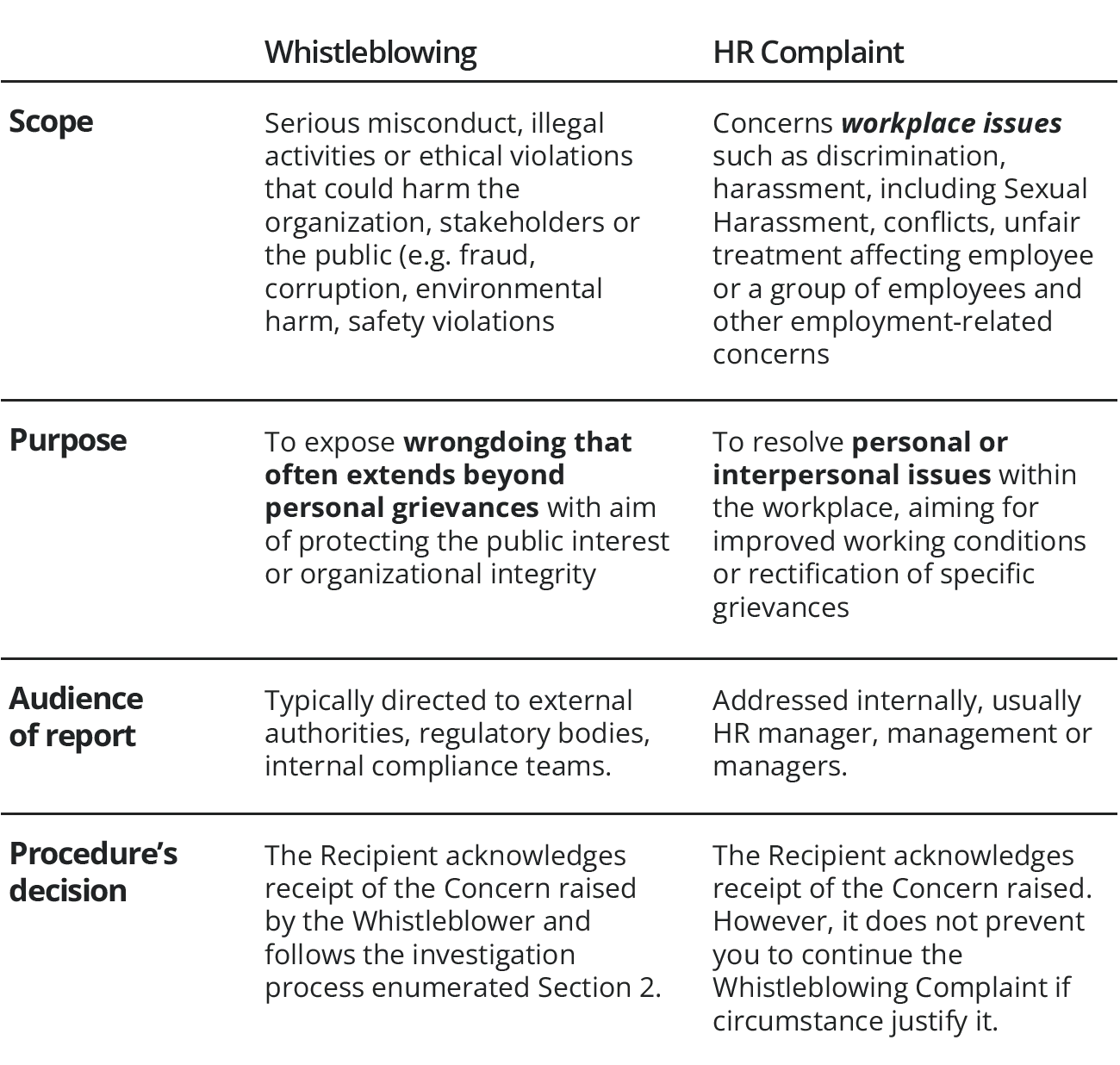
- What is the difference between a Whistleblowing and a HR Complaint?
2.2 Reporting of a Concern
2.2.1. Acting in Good Faith
Anyone reporting a Concern must act in good faith and have reasonable grounds for believing the information disclosed indicates a violation of law, GS Policies, and/or ethical standards. Any unfounded allegation that proves to have been made maliciously, recklessly, or knowingly to be false will be viewed as a serious offense and result in disciplinary action up to and including termination of employment, consultant, or volunteer status.
2.2.2. How to Report
If you or any individual who becomes aware of or receives information regarding a Concern, you are encouraged to report, it as soon as possible. You may raise your concern using one of the following methods:
- Directly to your manager: If you feel comfortable, you should start by raising your Concern with your immediate manager on his/her email address or orally.
- If you reasonably believe that the manager will disregard or otherwise not fairly consider your Concern, or if the manager is involved in the issue, then you can report to the Compliance Officer at [email protected].
- If the Compliance Officer is the subject of the Concern, or you are not comfortable reporting the Concern to the Compliance Officer, the Concern may be reported to the CEO.
- If the CEO is the subject of the Concern, the Concern may be reported to the Board Chairman at [email protected].
- If Board members are the subject of the Concern, the Concern may be reported to the Compliance Officer at [email protected].
Hereafter the “Recipient of the Concern”
The following outlines the available methods and procedures for reporting concerns, ensuring clarity, accessibility, and adherence to this Policy.
- Concerns may be reported orally (in person or via phone) or in writing (via email or letter at GS address at Chemin de Balexert 7-9, 1219 Vernier, Geneva, Switzerland.
- Concerns may be reported to an independent, third-party whistleblowing platform operated by an external service provider to enable secure and confidential reporting of Concerns. This channel is available at: [www.XXXXX.com] or [hotline]. This channel is designed to ensure neutrality, data protection compliance, and, where permitted by law, anonymity. Reports submitted through this platform will be transmitted to the designated Recipient of the Concern (typically the Compliance Officer) for handling in accordance with this Policy.
- You may choose to have a colleague or representative present when reporting your Concern.
Any questions relating to the scope, interpretation, or operation of this Policy should be directed to the Compliance Officer.
2.3 Confidentiality and Anonymity
GS is committed to handling all Concerns with the highest level of confidentiality, consistent with the need to conduct a fair and effective investigation. Information relating to a Concern, including the identity of the Whistleblower (where disclosed), the subject of the report, and any witnesses, will be shared strictly on a need-to-know basis and only with individuals involved in assessing, investigating, or resolving the matter. All persons involved in the process are required to maintain confidentiality and to use the information solely for the purposes of the investigation and resolution of the Concern.
GS will take all reasonable steps to protect the identity of the Whistleblower, including through:
- limiting access to identifying information;
- using anonymised or pseudonymised data where appropriate; and
- implementing secure handling and storage of records.
The identity of the Whistleblower will not be disclosed without their consent, unless:
- disclosure is required by law or regulatory obligation; or
- disclosure is necessary to ensure a fair investigation or to protect the rights of individuals involved.
In such cases, GS will, where legally permissible, inform the Whistleblower in advance. Concerns may be reported anonymously through the available reporting channels, including external whistleblowing platform.
While GS will assess and investigate anonymous reports to the extent possible, such reports may be more difficult to investigate effectively, particularly where:
- the information provided is incomplete or cannot be verified; or
- follow-up questions cannot be asked.
Whistleblowers are therefore encouraged, but not required, to disclose their identity to facilitate communication and investigation.
Confidentiality cannot be guaranteed in all circumstances. It may be necessary to disclose certain information in order to:
- conduct a thorough and fair investigation;
- comply with legal or regulatory requirements;
- protect the rights of the subject of the report; or
- take appropriate disciplinary or legal action.
Any such disclosure will be limited to what is strictly necessary and handled with appropriate safeguards.Where legally permissible, the Whistleblower will be informed in advance of any disclosure.
All personal data processed in connection with a Concern will be handled in accordance with applicable data protection laws, including the Swiss Federal Act on Data Protection (FADP).GS will ensure that:
- data is collected only for legitimate purposes related to the handling of the Concern;
- data is kept secure and protected against unauthorised access; and
- data is retained only for as long as necessary in accordance with GS record retention policies.
All individuals involved in the reporting, assessment, or investigation of a Concern (including managers, investigators, and witnesses) must:
- maintain strict confidentiality;
- refrain from unauthorised disclosure of information; and
- cooperate in preserving the integrity of the process.
Any breach of confidentiality may result in disciplinary action in accordance with the HR Code of Conduct and applicable policies.
2.4 Investigation Process of Reported
When a report is received by any manager, the Compliance Officer, CEO (the First Recipient of the Concern), the following steps will be taken:
- 1. Acknowledgment
The First Recipient acknowledges receipt of the report within 2/5 working days depending of the urgency of the Concern(s).
Acknowledgement of the Concern raised by you means the following steps to be followed by the First Recipient of your Concern:
- Ask the Whistleblower to describe what happened and follow up with clarifying questions as necessary.
- Document the conversation in detail.
- Explain the need for GS to conduct an investigation and request the Whistleblower's cooperation in the investigation.
- Inform the Whistleblower of the anti-retaliation policy.
- Assure the Whistleblower that the matter will be handled as confidentially as possible;
- The First Recipient, if it is not himself/herself the Compliance Officer, must promptly notify the Compliance Officer of such report in writing if appropriate.
2. Initial Assessment
The Initial Assessment shall be conducted by the Compliance Officer who may first select a more appropriate Recipient of the reported Concern(s):
a) If complex financial or technical violations are reported, the Compliance Officer or appropriate Recipient may immediately refer to external support in consultation with the CEO, if appropriate. External Support means an expert having specific experience appointed on a case-by-case basis.
b) The Compliance Officer or appropriate Recipient shall ascertain whether the Concern falls within the scope of this Policy or is governed by another applicable policy. For instance, if the Concern arises from personal or interpersonal issues within the workplace or relates to matters covered by the employment agreement, such as those addressed under the HR Policy, Employees Rules of Procedures, Employees Handbook or the Code of Conduct, the Concern may be redirected to the appropriate policy framework by the Compliance Officer or appropriate Recipient. This includes, but is not limited to, concerns involving harassment, discrimination, or other employment-related issues, which should be submitted to the designated Recipient for HR complaints.
However, this does not prevent the Whistleblower from continuing with the Whistleblowing Concern if, despite the Initial Assessment, the circumstances warrant it, in which case the procedure will continue with the other stages listed below.
c) Finally, the Initial Assessment shall be concluded with an evaluation of the timeline, and an agenda shall be established accordingly and communicated to the Whistleblower.
3. Investigation
The Compliance Officer shall appoint an appropriate independent investigator who will conduct a prompt, discreet and objective review or investigation based on the submitted report. A full investigation may not be possible if a report made anonymously is vague or general. If deemed necessary in his/her sole discretion or upon the recommendation of the Compliance Officer the investigator may engage legal counsel, accountants, or other experts to assist in the investigation.
For Concerns related to accounting practices, internal controls, or auditing matters, the investigator shall immediately notify the Audit Risk & Finance Committee and shall work with the CFO until the matter is resolved.
4. Updates
The whistleblower will be kept informed of the progress upon acknowledgement and at each step of the investigation process and any significant developments, subject to confidentiality and legal restrictions.
5. Conclusion
The independant investigator shall:
- Recommend appropriate corrective action to the CEO, if warranted by the investigation.
- Oversee the implementation of a resolution based on the determination of the CEO;
- Follow up with the reporting personnel, if possible, for closure of the reported Concern;
- Propose to the CEO any corrective action regarding the reported Concern to improve procedures to prevent future violations.
2.5 Protection from Retaliation
GS strictly prohibits any form of Retaliation against individuals who, in good faith:
- report a Concern under this Policy;
- participate in, assist with, or provide information during an assessment or investigation; or
- refuse to engage in conduct that may constitute wrongdoing.
Retaliation is a serious breach of this Policy and will not be tolerated under any circumstances. Protection from Retaliation applies to:
- Whistleblowers (whether identified or anonymous, to the extent possible);
- individuals supporting or advising the Whistleblower;
- witnesses and persons participating in the investigation; and
- any individual associated with the Whistleblower who may be exposed to Retaliation.
Protection applies regardless of whether the Concern is ultimately substantiated, provided it was reported in good faith.
Retaliation may be direct or indirect and includes any adverse action or threat thereof, such as:
- dismissal, suspension, demotion, or denial of promotion;
- reassignment to less favourable duties or changes in working conditions;
- harassment, intimidation, or exclusion;
- negative performance evaluations or disciplinary measures without justification;
- damage to reputation or career prospects;
- termination or alteration of contracts with external parties; or
- any other action that would discourage a reasonable person from reporting a Concern.
Any individual who believes they have been subject to Retaliation, or who becomes aware of potential Retaliation, must report it immediately to:
- the Compliance Officer; or
- another appropriate Recipient under this Policy (including escalation routes where conflicts exist).
Reports of Retaliation will be:
- treated as a serious and separate Concern;
- assessed promptly and, where appropriate, investigated independently; and
- prioritised to ensure timely protection of affected individuals.
Any Personnel found to have engaged in Retaliation will be subject to disciplinary action, up to and including termination of employment or contractual relationship, in accordance with:
- the Code of Conduct;
- the Employee Handbook; and
- applicable legal and contractual obligations.
Where Retaliation involves external parties, GS may take appropriate action, including:
- termination of business relationships;
- enforcement of contractual remedies; and/or
- referral to relevant authorities where warranted.
Protection under this section applies only where the Concern was reported in good faith and with reasonable grounds to believe it was true. Knowingly false, malicious, or reckless allegations may result in disciplinary action and are not protected under this Policy.
2.6 Interim Protection of Employees
Where there is a risk of ongoing or potential Retaliation, GS may implement appropriate interim measures to protect the affected individual, including:
- temporary adjustments to reporting lines or duties;
- remote working arrangements or leave;
- separation of individuals involved; or
- other proportionate measures deemed necessary.
Such measures will be implemented in consultation with HR and in accordance with the Code of Conduct and applicable employment law.
2.7 Record Keeping
All reported Concerns and investigation records will be securely stored and accessible only to the Compliance Officer. GS will maintain a Whistleblowing register that logs reports, investigation outcomes, and any follow-up actions. Records will be kept in accordance with Swiss data protection laws.
2.8 External Reporting
While GS encourages internal reporting, it acknowledges that there may be circumstances where reporting to external authorities is necessary. Whistleblowers are advised to seek legal counsel before making external disclosures to ensure compliance with relevant laws. GS respects the right of individuals to report concerns to regulatory bodies or police if they feel appropriate action has not been taken.
3. Effective Date and Review of Policy
Effective date: This Policy comes into effect immediately upon approval of the Board.
3.1 Periodic reviews
To ensure that GS operates in a manner consistent with non-for-profit purposes and does not engage in activities that could jeopardize its reputation or tax-exempt status, the EMT shall conduct periodic reviews of this Policy. The Compliance Officer shall present any recommended changes, modifications, or deletions of the provisions of this Policy to the Board.
The Board should periodically review the whistleblower policy to ensure that:
- The policy adequately addresses the needs of GS.
- The policy addresses legal requirements.
- The policy is followed and enforced.
- Current arrangements are still reasonable and advisable.
3.2 Miscellaneous
- 1. Compliance with this Policy is mandatory for all GS staff members, and violations will be taken seriously to protect the integrity and reputation of Gold Standard. Failure to comply with this Policy and procedures may result in disciplinary actions, including:
- Warnings and reprimands.
- Suspension or termination of contract.
- Reporting to relevant authorities for potential legal action.
2. The dissemination of the Policy is under the following methods:
- By providing the policy to all GS Personnel with an acknowledgement form to sign through GS HR Information System; or
- Discussing policies at the time of hire or during a new hire orientation session (or both); or
Communicating the policy in any other way that ensures all Personnel receive and understand it.
Training on the implementation of this Policy may be organized to all new Board members, managers, and employees that explains: (i) the reporting and investigation procedures outlined in the policy, (ii) the protection available to Whistleblowers under the policy, (iii) the correct procedures for managers to follow when handling Whistleblower claims, (iv) the disciplinary and legal repercussions of non-compliance with the policy, including GS’s strict prohibition of retaliation.
Governance flowchart
1. Submission of Concern
Whistleblower submits concern
↓
Identify "First Recipient"
(Manager / Compliance Officer / CEO / Board Chair / others)
2. Acknowledgment & Intake (Gate 1: Completeness)
First Recipient acknowledges within 2–5 working days
↓
Collect initial information:
- Facts, dates, persons involved
- Supporting evidence (if any)
- Preferred confidentiality level
↓
Explain:
- Confidentiality limits
- Anti-retaliation protections
- Investigation process
↓
Check Conflict of Interest
↓
Record in Whistleblowing Register
• Is the report made in good faith?
• Is there sufficient information to proceed?
If NO → Request further information OR close with documented rationale
If YES → Escalate to Compliance Officer
3. Initial Assessment (Gate 2: Qualification & Routing)
Compliance Officer performs Initial Assessment
↓
Classify the Concern
Is this a Whistleblowing Concern?
If YES → Continue under Whistleblowing Policy
If NO → Redirect to appropriate framework:
- Director, HR (HR Code of Conduct / HR Policy)
- Director, Standard Development & Innovation (GS4GG grievance mechanisms)
If financial/audit issue → notify CFO/Audit Risk & Finance Committee (in consultation with
the CEO)
If highly technical → engage external expert (in consultation with the CEO)
4. Investigation Decision (Gate 3: Go / No-Go)
Is formal investigation warranted?
If NO → Close case with justification + notify whistleblower
If YES → Launch investigation
Assign investigator (internal or external)
↓
Define scope, timeline, and investigation plan
↓
Conduct investigation:
- Interviews
- Document review
- Data analysis
↓
Ensure:
- Independence
- Confidentiality
- Legality of any interim measures
- Protection against retaliation (interim measures)
5. Reporting & Updates
Provide periodic updates to whistleblower (subject to confidentiality/legal constraints)
6. Conclusion & Decision (Gate 4: Outcome Determination)
Investigation report completed
↓
Investigator formulates findings:
- Substantiated
- Unsubstantiated
- Inconclusive
↓
Submit recommendations to CEO (or Board if needed)
7. Outcome Actions
CEO / competent authority decides on actions:
• Disciplinary measures
• Corrective actions
• Referral to authorities
• No action (with justification)
All disciplinary measures must follow the HR Code of Conduct, Employee Handbook, and
applicable contractual and Swiss employment law requirements.
8. Closure
Inform whistleblower (where possible)
↓
Document outcome in register
↓
Implement corrective actions
↓
Close case