
Community service projects enable carbon credit buyers to align their climate investments with both environmental integrity and meaningful social impact. They connect vulnerable communities to essential resources, while delivering verified emissions reductions.

These projects exemplify what the carbon market was originally designed to do: channel capital from where emissions are hardest to cut, to where finance can drive the greatest and most durable change.
What are Community Service Projects?
Community service projects focus on meeting basic human needs while addressing climate change, by providing or improving access to essential social services at the household, community or institutional level. Activities typically include:
Energy efficiency
Such as improved cooking solutions or lighting projects.

Clean water
including sanitation and hygiene initiatives.

Off-grid renewable energy
for instance, solar home systems.

These are not peripheral climate solutions. They are foundational.
Why Community Service Projects are Essential
Community service projects support people on the front lines of climate change by providing more time, income and opportunity, enabling communities to improve livelihoods and build a more sustainable future. Beyond emissions reductions, they intentionally deliver co-benefits aligned with the United Nations Sustainable Development Goals (SDGs), improving health, resilience and local environments.
In other words, they address the reality that climate action and development are inseparable in much of the world.
Why Businesses Should Integrate Community Service Projects into Climate Strategies
Strategic contribution to global net zero: Clean cookstove projects offer a clear example of why community service projects matter. Traditional biomass-based cooking accounts for around 2% of global emissions, roughly equivalent to the aviation or shipping sectors. According to the International Energy Agency (IEA) and the UNFCCC, achieving net zero by 2050 is not possible without addressing the climate impact of inefficient cooking.
Yet this challenge remains chronically underfunded. The IEA estimates that universal access to clean cooking by 2030 would require only US $8 billion per year, with a further US $1.5 billion annually to sustain adoption. By investing now, organisations can deliver immediate climate benefits while helping to manage the long-term costs of achieving net zero.
Read also Aviation’s Biggest Climate Opportunity Is In Clean Cooking.
- Benefits beyond carbon: These projects improve public health by reducing household air pollution and water-borne disease. They promote gender equity and children’s education by easing the burden of fuel and water collection, freeing up time for education, income-generating activities or leisure. They also support economic empowerment through job creation and household cost savings.
Crucially, community service projects protect natural ecosystems by reducing pressure on forests used for fuelwood, helping to curb deforestation while improving livelihoods.
- Credibility for portfolios and business strategies: Clean cooking is rated five-star for additionality by the Carbon Credit Quality Initiative, reflecting the reality that these projects would not reach scale without carbon finance. Their credibility has been significantly strengthened by advances in methodologies, monitoring technologies and governance frameworks.
These projects adhere to rigorous international standards, ensuring environmental integrity and fostering trust among stakeholders. Technological innovations ensure that emission reductions are accurately calculated, reflecting real-world usage patterns and supporting high levels of transparency and confidence in reported outcomes. Monitoring, reporting, and verification protocols have evolved to incorporate rigorous field-based procedures.
Measuring what Matters: Community and Social Impacts
Different projects deliver different impacts, which can be measured through SDG contributions and by estimating the economic value of benefits related to climate, health, ecosystems and livelihoods (ie shared value).
For example, in low-income rural communities where animal manure is often stored in open pits, biogas digesters convert waste into clean, affordable energy for cooking, heating and lighting. A single project can contribute to multiple SDGs:
Good health and wellbeing

Reduced indoor air pollution and improved hygiene
Quality education

Training of qualified biogas technicians
Affordable and clean energy

Access to reliable biogas for cooking, lighting or heating
Decent work and economic growth

Jobs in construction and maintenance of biogas plants
Climate action

Ongoing emissions reductions
Life on land

Reduced firewood use and the replacement of chemical fertilisers
This is what integrated climate action looks like in practice.
Here are some real examples of the benefits beyond carbon that community service projects can deliver.
The Economic Case: Shared Value
Independent assessments of Gold Standard-certified projects estimate the shared economic value created across four impact channels: climate, ecosystems, livelihoods and health. The methodology focuses only on impacts that can be robustly quantified, meaning it underestimates total benefits, including gender, education and universal access to energy. For every carbon credit issued, the average value created is:
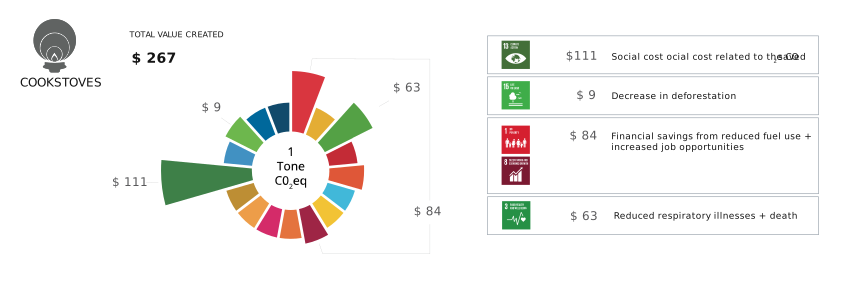
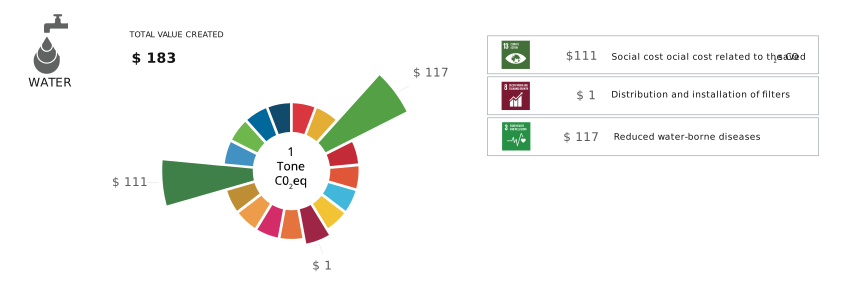
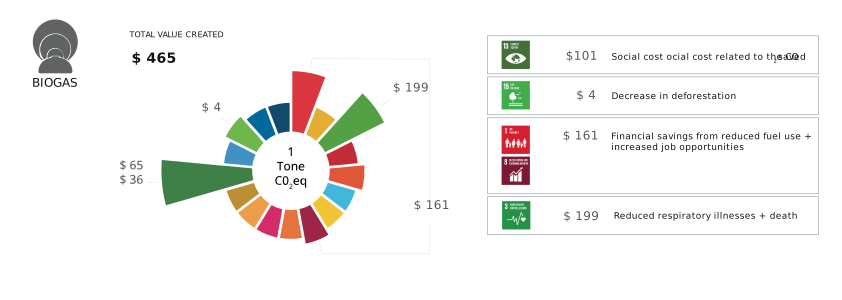
Few climate interventions deliver such a high level of return across multiple social, environmental and economic dimensions.
Why Price Matters in Carbon Markets
Carbon credits vary in price because they represent far more than a tonne of CO2e. They fund projects that require planning, community engagement and long-term monitoring to deliver verified impact. Cookstove projects, for example, depend on training, distribution and usage checks to maintain results.
On the Gold Standard Marketplace, a Fairtrade-inspired minimum price helps ensure projects remain viable and continue delivering benefits for people and nature. Developers can set rates above that floor based on proven value. A fair price matters because it protects impact.
What Quality Looks Like
Gold Standard-certified projects combine:
Trust and credibility
As a mission-driven organisation, Gold Standard upholds the highest integrity standard in the market, backed by rigorous and credible third-party verification and embedding continuous science-aligned improvements.
Real Impact
According to the International Energy Agency (IEA) and the UNFCCC, reaching global net zero by 2050 is not possible without addressing the climate impact of inefficient cooking. These projects improve energy efficiency and offer a real, immediate action.
Verifiable SDG contribution
The project SDG contributions can be transparently checked in our public Impact Registry.
Transparent transactions
You can purchase Gold Standard-certified credits on our marketplace platform with a few simple clicks. Credits are retired from our public Impact Registry in real time and buyers receive a certificate.
They also align with emerging global benchmarks, including ICVCM Core Carbon Principles, with Gold Standard issuing its first ICVCM CCP eligible credits from clean cooking methodologies last year.
Gold Standard also has projects with CORSIA eligibility, reinforcing their role in the future of high-integrity carbon markets.
A Final Thought
If carbon markets are to retain credibility, they must deliver more than accounting outcomes. Community service projects show what is possible when climate finance is directed to where it can do the most good, for people, for nature, and for the climate. This is not charity. It is smart, necessary climate action.