Livestock methane is one of agriculture’s most impactful emissions to reduce, yet it receives little funding. The challenge is not a lack of science or effort, but that measurement systems have not reached the smallholder farms responsible for most of these emissions. Gold Standard’s latest methodology, HERD, builds on existing work to help smallholders reduce methane emissions.

Herd Emission Reductions in Dairy (HERD) is open for public consultation until 4 October 2026 at 18:00 CEST
Submit your feedback
Why methane, why now?
Not all greenhouse gases are equal in impact. Whilst CO2 lingers in the atmosphere for centuries, methane breaks down in twelve years, but traps roughly 84 times more heat while it's there. Cut methane now, and the planet feels it within a decade, which is why over 150 countries have signed the Global Methane Pledge, targeting a 30% cut from 2020 levels by 2030. However, the Pledge's own COP30 tracking report says the world is off track.
Agriculture produces close to 40% of human-caused methane, more than the entire fossil fuel sector's 35%. If the fastest lever for near-term climate progress sits inside one sector, that sector should be a climate priority.
Named, not measured
94% of governments call adapting agriculture to climate change a priority; 91% say the same about cutting its emissions (The Food and Agriculture Organization (FAO), 2025). But only about half include sector-specific targets for it. National climate plans globally currently target only around 40% of agrifood-system greenhouse gas emissions. Livestock, the sector's single largest emitter, is among the most neglected: 66% of its emissions sit outside any concrete national plans (FAO, 2025).
Part of the reason is structural, not neglect. When a country decides which reductions to sell internationally under Article 6, it may reasonably prefer to keep agriculture for its own target: it is often the largest slice of the national inventory and the hardest to replace. So agricultural mitigation tends to appear not in export frameworks but in national climate plans as a costed commitment. Rwanda’s plans, for example, include expanding animal-breeding centres to cut enteric methane per unit of output, usually within the conditional tier that depends on international finance. That leaves it leaning on domestic policy and results-based public finance, and those need credible measurement at least as much as a carbon credit does.
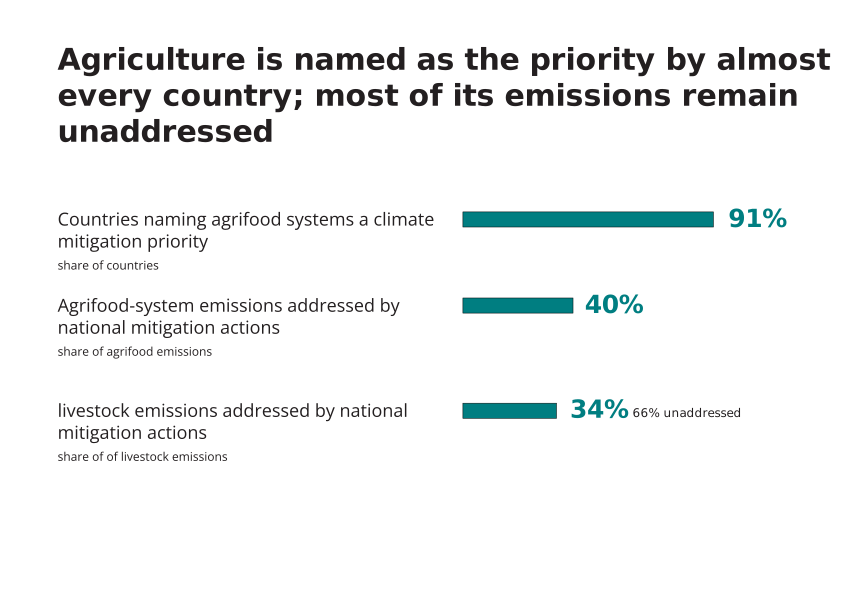
Source – FAO 2025- Agrifood systems in nationally determined contributions: Global Analysis
Built for the wrong problem
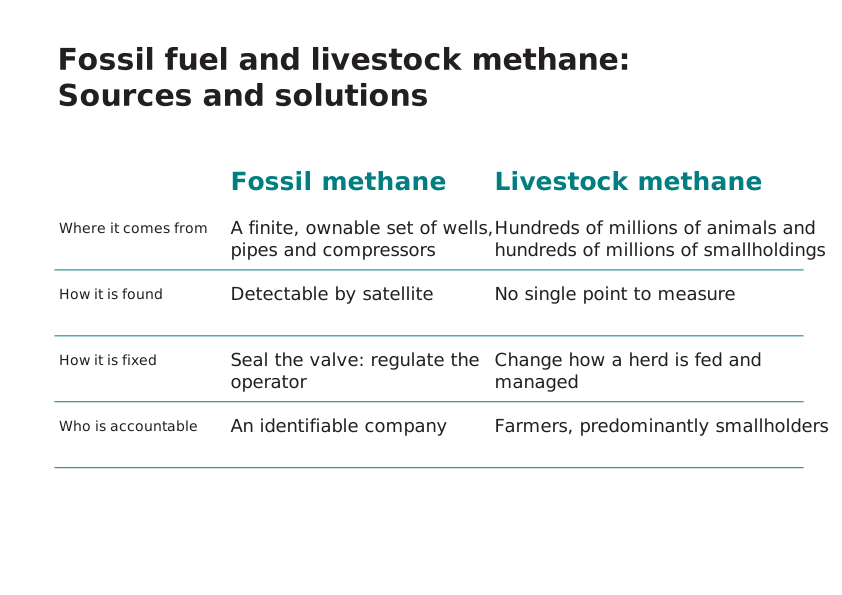
Methane from oil and gas comes from a limited number of identifiable pipes, wells and facilities. Many leaks can be detected by satellite and fixed by repairing or replacing equipment. The EU Methane Regulation and US EPA rules were designed for this kind of problem.
Livestock methane is much more widely dispersed, coming from hundreds of millions of animals on small farms. Livestock farming is closely linked to food security, livelihoods and culture, so approaches designed for oil and gas cannot simply be applied. This may help explain why the Global Methane Pledge identifies energy as having the greatest potential for near-term reductions, even though agriculture produces more methane overall.
HERD is one of several Gold Standard livestock methodologies, alongside manure management and biogas (AWMS) and in-situ capture of enteric methane, both Paris-aligned, and feed supplementation for enteric fermentation. What sets it apart is that it is the only one built for smallholder systems. Extensive and pastoral systems remain the harder case, with early-stage concepts in consideration but no equivalent answer yet.
The barrier is measurement, not solutions
Mitigation science for livestock exists and continues to improve, for example, through feed adjustments, improved manure management, and gains in herd efficiency. What's missing is proof credible enough to attach finance to, in places unaccustomed to measuring such data.
Fortunately, new measurement efforts don’t have to start from nothing. FAO’s GLEAM model has quantified livestock emission intensities across production systems worldwide for over a decade; IPCC inventory methods give every country a way to count its herd; and in 2016, FAO, ILRI and Gold Standard published the first standardised baseline methodology for smallholder dairy.
Supporting this is a growing set of efforts to move from counting to acting. The Global Methane Hub’s Enteric Fermentation Accelerator has mobilised US$70 million toward a 30% cut in enteric methane by 2030; CGIAR centres are breeding low-methane forages; IFAD has supported 17 countries in bringing agricultural methane into their national climate plans; and FAO convened its first technical consultation on livestock carbon markets in October 2025. What remains is to reach the individual smallholder programme with a baseline credible enough to carry finance.
It is critical to begin measuring these emissions. To date, only 12 agricultural projects have ever issued carbon credits in Africa. Over 80% of global agricultural credits are drawn from just two project types, methane reduction and rice cultivation, rather than from the smallholder systems that need them most. Moreover, much of the existing mitigation toolkit was built for confined, industrial-scale farms with fences and feed troughs. But that isn't where most of the world's livestock keepers operate.
An opportunity, not a burden
Non-Organisation for Economic Co-operation and Development (OECD) countries produce 71% of the world's dairy emissions and 77% of its beef emissions. That's usually read as a problem, but it's also an opportunity. FAO's models show emissions per litre of milk vary twentyfold across grassland systems worldwide, and as much as fiftyfold for beef, according to one Kenyan smallholder study.
The same herd, managed differently, can produce the same food with a fraction of the emissions. This means the region that already keeps the animals is also the one best placed to cut the emissions, and to receive the finance for it.
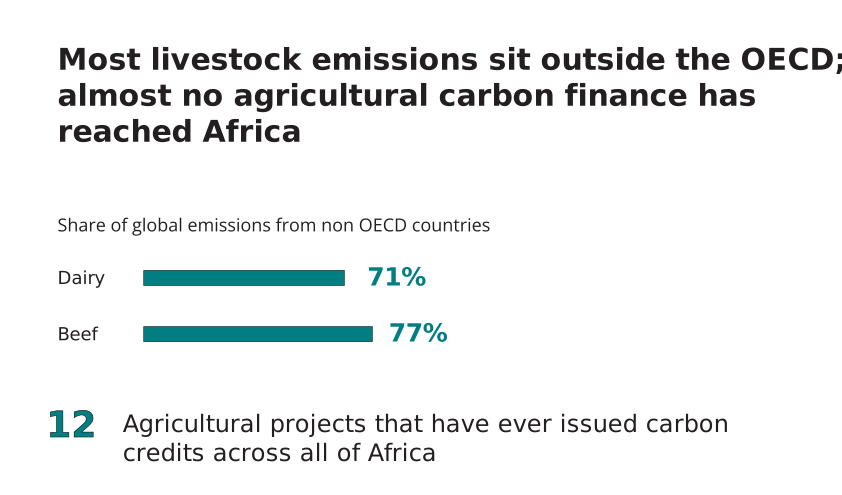
Sources - CSIS 2025 Methane reduction in Livestock: Confronting the North-South Gap; SAIIA
From project to programme
Scaling the financing approach to the national strategy level, rather than project level, has started to unlock national-scale access to clean cooking, water and electricity. The same strategy is needed for livestock emissions.
FAO set out the technical approach at COP25: namely, efficiency gains, circular use of waste, nature-based offsets, healthier diets, and the policy measures to drive them. What remains is implementation, and that depends on measurement that works at scale.
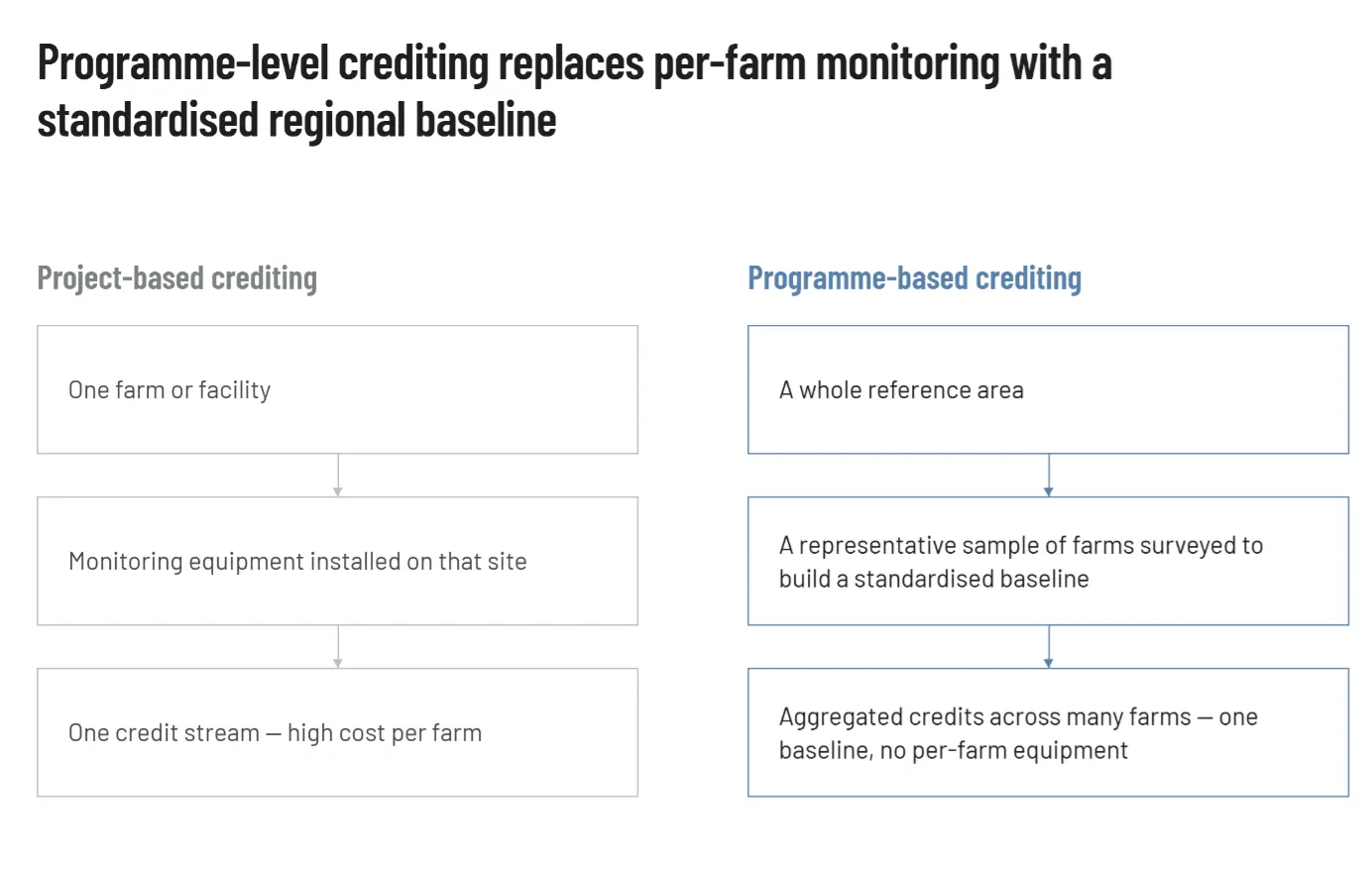
For a sector built on millions of small, dispersed producers, that means moving away from monitoring every single holding, and towards a policy-based approach: set a baseline for an entire region using survey data and a representative sample of farms, then measure collective progress against it. That shift, from project-by-project to programme-level crediting, is what makes a country-wide strategy financeable.
A methodological solution
HERD is Gold Standard’s contribution to that step. It is the successor to the 2016 FAO/ILRI/Gold Standard smallholder dairy methodology, measures emission intensity per unit of milk on the same yardstick FAO’s GLEAM uses, and is built for smallholder cattle and buffalo herds of 100 animals or fewer, in communities where farms have no emissions monitoring equipment and often no formal audited herd records, and where milk-yield data can come from farmer recall cross-checked against collection-centre records.
The methodology works by surveying a representative sample of a reference area to set a standardised baseline, then using a regression model built on milk yield and herd management practices to predict each farm's emission intensity within that area, rather than requiring every farm to build its own counterfactual baseline from scratch. It also accounts for enteric fermentation, manure, nitrous oxide, feed and replacement animals together. It's a programmatic, survey-based approach, built specifically for dairy.
This is not a call to choose agriculture over energy, or the Global South over other climate priorities. But a sector responsible for 40% of the fastest-acting greenhouse gas humanity produces, and one that feeds and employs more than a billion people, deserves a mitigation strategy built for what it actually is.
Have your say in how this could be managed by leaving feedback on HERD’s public consultation, open until 4 October at 18:00 CEST.
Submit your feedback