
Reducing emissions within your full value chain remains the priority. However, most organisations continue to generate emissions that cannot yet be eliminated. High-integrity carbon credits are one credible way to enable organisations to take responsibility for these emissions today while contributing to global climate action.
What is a carbon credit?
A carbon credit represents one tonne of greenhouse gas emissions that has been reduced, avoided or removed from the atmosphere through a certified climate project.
Carbon credits enable organisations to channel finance towards climate action, supporting projects that reduce or remove emissions while delivering wider environmental and social outcomes. When purchased and retired, credits provide a transparent and verifiable way for organisations to take responsibility for emissions that remain while they continue to decarbonise.
See Scaling Carbon Dioxide Removal: Why corporate targets matter and what companies can do now
What makes a carbon credit high integrity?
As the voluntary carbon market evolves, quality matters more than ever.
High-integrity carbon credits See High Integrity Carbon Credits | GS should demonstrate:
- Real impact through measured and verified emission reductions or removals.
- Independent verification by accredited third-party auditors.
- Transparency with publicly available project documentation.
- Traceability through secure issuance, transfer and retirement systems.
- Strong governance underpinning standards, methodologies and oversight.
- Sustainable development benefits that extend beyond carbon outcomes.
These principles help ensure that carbon finance delivers meaningful climate impact and supports confidence in the voluntary carbon market.
Why choose Gold Standard credits? Integrity, transparency and impact beyond carbon
Gold Standard's approach to integrity includes Read Why Gold Standard Carbon Credits :
- Independent third-party validation and verification.
- Full transparency through publicly available project documentation.
- Traceability through the Gold Standard Impact Registry.
- Rigorous governance and oversight processes.
- Alignment with the Paris Agreement, which means our methodologies are designed to contribute to climate mitigation pathways consistent with limiting warming to 1.5°C.
All Gold Standard credits are transparently issued, transferred and retired through the Gold Standard Impact Registry. The registry provides a public record of project information and credit transactions, helping ensure transparency and accountability. Using the registry, buyers can:
- Verify retired credits.
- Access project documentation.
- Review monitoring and verification reports.
- Explore certified SDG impacts.
- Track credits using unique serial numbers.
Unlike carbon credits that focus solely on carbon, Gold Standard projects also deliver verified benefits for people and nature. Every Gold Standard project delivers verified climate action and alongside measurable sustainable development outcomes: it contributes to at least three Sustainable Development Goals (SDGs), including SDG 13 (Climate Action) and at least two additional goals. Depending on the project type, impacts may include:
- Improved access to clean energy.
- Better health outcomes.
- Safe drinking water.
- Increased income and economic opportunity.
- Biodiversity protection.
- Community resilience and sustainable livelihoods.
By supporting Gold Standard projects, organisations contribute towards climate security and sustainable development simultaneously. The proof is in the numbers: from clean cooking in Somalia, where a Gold Standard-certified project has improved access to efficient cookstoves for around 900,000 people, to community-led forestry in Timor-Leste, where more than 80% of carbon revenues are channelled directly to local farmers and communities, whilst sequestering carbon and protecting biodiversity.
Recognition for Gold Standard credits
Gold Standard carbon credits are widely recognised by a number of governments, compliance schemes, and programmes. For example:
- Gold Standard is a member of the ISEAL Alliance, the leading membership body for credibility in sustainability systems.
- We have received recognition by the Integrity Council for the Voluntary Carbon Market (ICVCM), with Gold Standard among the first standards approved under its Core Carbon Principles (CCP) programme. The International Civil Aviation Organization (ICAO) officially recognises Gold Standard as an eligible crediting program to supply carbon units for the Carbon Offsetting and Reduction Scheme for International Aviation (CORSIA).
- Governments in Africa, Asia and Latin America recognise our credits as eligible under national carbon pricing policies.
- Our credits are independently acknowledged as having the strongest safeguards in the carbon market by the Okeo-Institut.
Carbon credits within a credible climate strategy
Carbon credits should complement, not replace, emissions reductions.
Organisations are increasingly adopting Ongoing Emissions Responsibility (OER) strategies, combining ambitious decarbonisation efforts with investment in climate action beyond their value chain. High-integrity carbon credits can help organisations take responsibility for ongoing emissions while contributing to global net zero.
Gold Standard has developed practical guidance to help organisations integrate high-integrity carbon finance into credible climate strategies. Read How carbon credits fit into a credible net-zero strategy
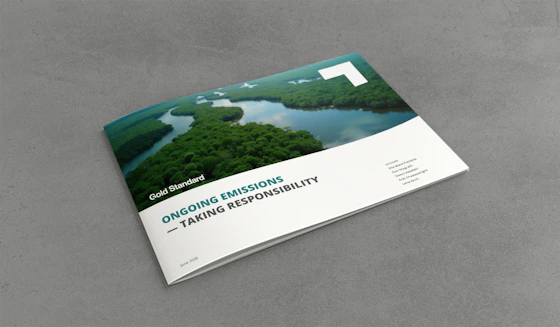
Ongoing Emissions – Taking Responsibility
Buying Gold Standard credits
Gold Standard offers multiple options for purchasing certified carbon credits:
1 | Gold Standard Marketplace
A simple and transparent way to purchase and retire credits directly from certified projects. Suitable for organisations purchasing smaller volumes of credits.
Read Why use Gold Standard Marketplace - turning climate targets into tangible change to learn about the Gold Standard difference and why it matters.
Explore Marketplace
2 | Climate+ Portfolio
A curated portfolio of high-impact projects offering volume pricing for larger purchases. Available across a range of project types, including community-based projects, renewable energy and water access initiatives.
3 | Specialised credit requirements
Gold Standard can also support organisations seeking Article 6-labelled credits; CORSIA-eligible credits or unretired credits for brokers, consultants and climate solution providers.
Can Gold Standard credits be used in compliance programmes?
In some jurisdictions, including Chile, Colombia, Singapore and South Africa, eligible Gold Standard VERs can be used under national carbon tax frameworks, subject to local rules and requirements.

For more information on quality carbon credits, please contact Melanie Knight, Manager, Corporate Engagment
[email protected]
Gold Standard Project Spotlights
Every Gold Standard project makes verified contributions towards a minimum of 3 of the United Nations Sustainable Development Goals (SDGs), always including SDG 13 (climate action) and two others, with many projects going beyond the minimum. But what does this mean in reality? The Gold Standard Project Spotlights bring the numbers to life by telling the inspiring stories of the local community members and project developers - those who are making sustainable development a reality.
Project Spotlights
Next Communicate your Climate and Nature Action